Essay
A Future Education System
What if . . instead of the failures of students, we focused on the failure of systems?. . and used that understanding to collectively reimagine education?
Jen Stumbles
·
·
8 min read
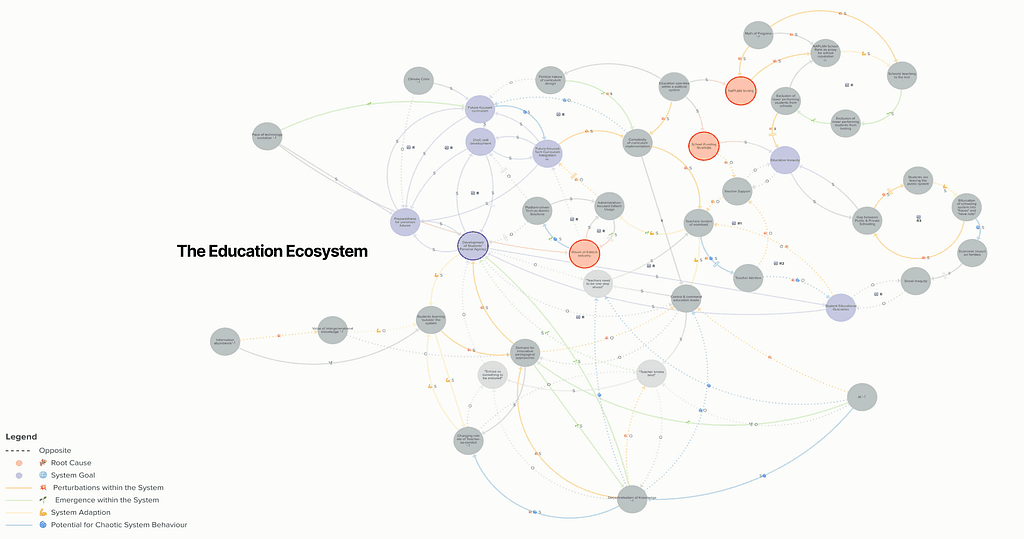
01 / The essay
Essay in full, as published.
The characteristics of complexity
In traditional systems thinking, we understand the components of a system as parts which fit together to form an overall process.
We believe we can define, measure and control how those parts function together — which is to say, we can understand and predict the functioning of the entire system simply by looking at its parts.
Complex adaptive systems however, are characterised by the dynamic relationships between(decentralised) system parts and how their interactions respond, interact and shape the functioning of the whole system — eventually modifying the system’s relationship to its environment.
It is the interactions between these parts which produces novel reactions; this leads to further self-organising and stabilising behaviours. These behaviours cannot be predicted and over time, they collectively shape the system as a whole (emergence).
Due to the distributed nature of complex adaptive systems, there is no centralised control. However the initial functioning of the system parts are sensitively dependent on initial conditions and system laws, which enable a level of system cohesion despite the localised adaptive behaviours occurring throughout.
The education system operates as a complex adaptive system
The education system represents a multitude of distributed interconnected goal-orientated subsystems which interact dynamically in non-linear patterns to form an overall macro system.
Examples of subsystems within the education system include the school subsystem, education leadership and administration subsystems, teaching, student and parent subsystems. Each of these areas operate independently with their own goals, agents and behavioural dynamics at a local level, and are also interconnected and operate within the context of the goals and behaviour of the overall education system.
These local subsystems respond both to the environment and the systems with which they interconnect, aggregating at a macro systems level to form what we know as ‘the education system’.
What defines the education system as a complex adaptive system, is its ability to support system learning, self-organisation and emergence to produce adapted behaviour.
Characteristics of the system
The education system is self stabilising in that it responds to data from feedback mechanisms in the external environment such as standardised test scores, global comparison rankings and teacher / parent / student feedback to learn and adapt its behaviour.
We see the impact of these feedback mechanisms within subsystems as schools evolve teaching pedagogies or shift curriculum focus.
Stabilising also occurs at a macro level where we see educational reform which extends across multiple subsystems toward the overall macro system goal of improved student educational achievement outcomes.
The distributed Agents (such as teachers, school leaders, administrators) within each level of the system are autonomous, proactive, reactive and socially interconnected, enabling them to operate locally within the context of the larger education system.
The education system is purposeful and goal-directed both at a macro level — purposefully functioning toward a threshold of educational outcomes or achievement, and also at a subsystem level, where goals are independently set within the context of a smaller localised system context such as a classroom or a school.
An example of this would be programs focused on core comprehension skills to improve literacy across primary school students which achieves both a local goal (improved primary school student literacy) and also works in harmony with the macro system goal of improved student achievement.
View the live interactive system maps on Kumu here
Root Cause : Funding Shortfalls — Part A
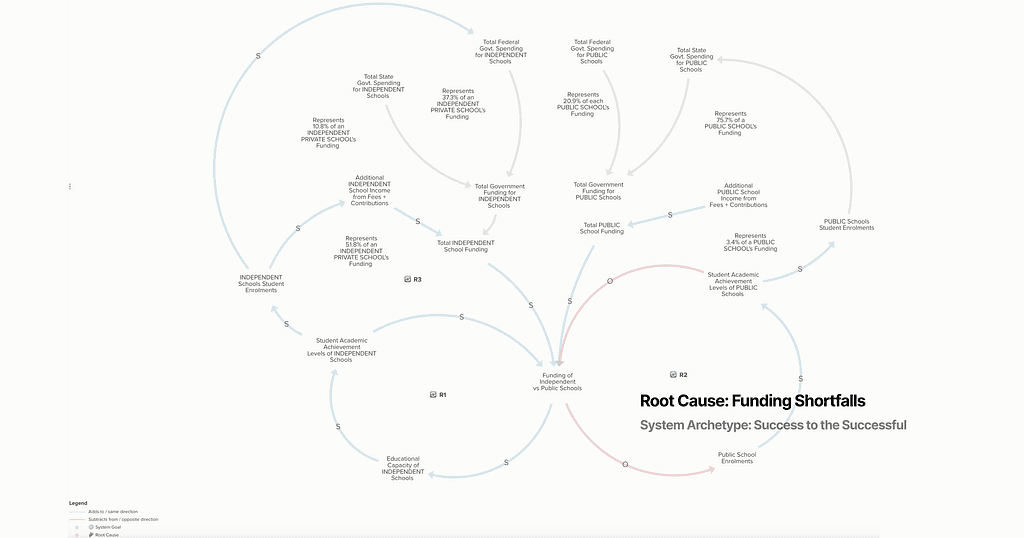
📌 System Archetype: Success to the Successful
This archetypal behaviour describes the way that a well funded school’s success reinforces further success, at the expense of others.
View the live interactive system maps on Kumu here
Independent Schools : Success Reinforces Success 🔄 R1 🔄 R3
Increased Funding to Australian private independent schools vs Public Schools increases their Educational Capacity. Increased Educational Capacity within independent schools leads to increased levels of Student Academic Achievement.
Increased levels of Student Academic Achievement — leads to increased Independent School Enrolments, which leads to increases in Independent School Fees (which make up a large proportion of their overall income), and increased Government Funding, which increases the level of overall Independent School Funding available, functioning to reinforce this cycle of success.
Public Schools: A Vicious Circle of Inequity 🔄 R2
Decreased Public Schools Funding leads to comparably lower Educational Capacity, which leads to lower Student Academic Achievement Levels, which also leads to reduced Public School Enrolments, which further reduces Funding for Public Schools. The systemic underfunding of Public Schools creates a self-reinforcing pattern of disadvantage and inequity.
The Federal Government (who provides the majority of Independent School Funding), has historically been funding schools more in line with Schooling Resource Standards. In many cases, Independent Schools have been overfunded relative to the levels recommended by the Schooling Resource Standards.
Whereas the State Government (who provides the majority of Public School Funding), has not been funding schools to the level recommended by the Schooling Resource Standard due to competing budgetary pressure from health and other social services. In many cases schools are currently being funded well below the levels recommended by the Schooling Resource Standards.
Source: NSW Public Funding Schools and the School Resourcing Standard
Root Cause : Funding Shortfalls — Part B
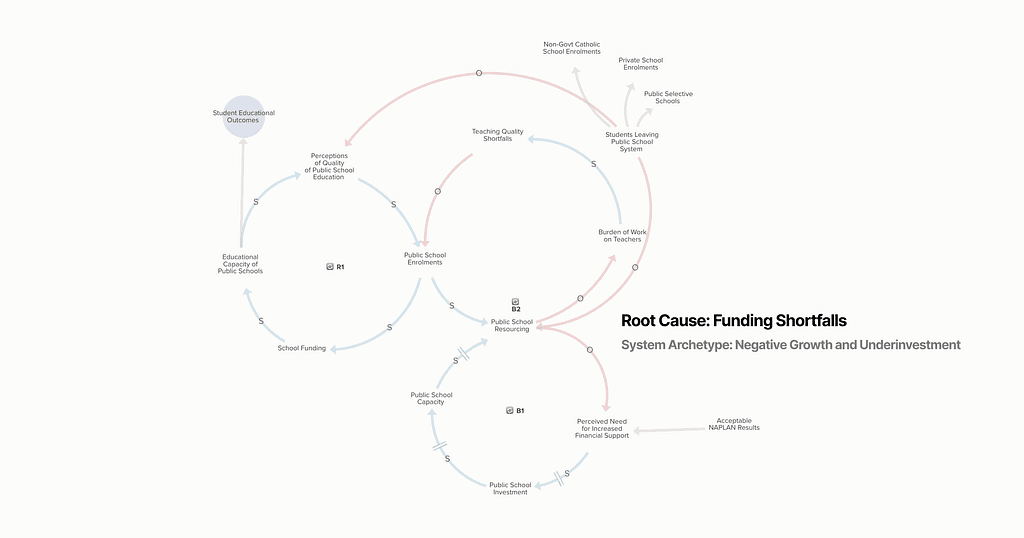
📌 System Archetype: Negative Growth and Underinvestment
The systemic failure of the underfunding of schools can also be expressed as a Negative Growth and Underinvestment systems archetype.
View the live interactive system maps on Kumu here
🔄 R1 Less Public School Funding leads to decreases in Educational Capacity which in turn, leads to lower Perceptions of Quality of Public Education, which leads to decreasing Public School Enrolments which leads to less Public School Resource Levels
🔄 B1 Decreasing Public School Resource Levels highlights a need for increasing Financial support — which (hopefully) leads to increasing Public School Investment, which would enable more Public School Capacity. The more Public School Capacity, the more Public School Resource Levels.
Public School Inequality is further intensified by the resulting Public School Exodus.
As School Achievement Levels decline, we see an increase in Students Leaving the Public System, which leads to both a lowering of Perceptions of the Quality of Public School Education and a decrease in Public School Enrolments.
Funding and Resourcing Delays amplify Disadvantage in Public Schools
The challenge here is that there is often a major delay between the education system identifying decreasing Public School Resource Levels and recognising a school’s Perceived Need for Increased Support and Public School(s) Investment There is also a significant delay between any increase in Public School Investment and increases in Public School Capacity (due in large part to ongoing teacher shortages), leading to a further delay in the eventual increase in School Resource Levels.
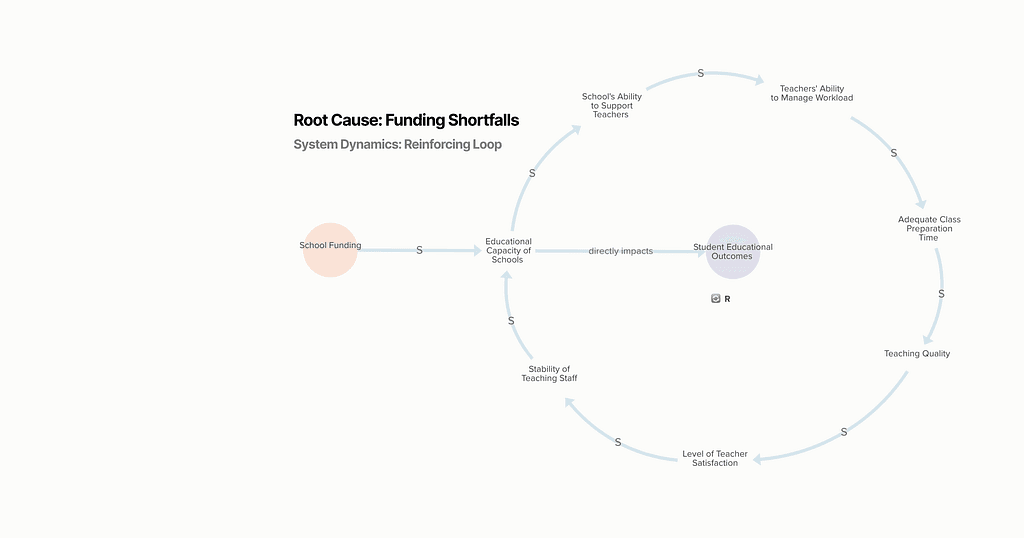
📌 System Dynamics: Reinforcing Loop
View the live interactive system maps on Kumu here
Increasing the educational capacity for schools acts as a critical reinforcing mechanism for school stability and amplifies the human capital within the system.
School Funding: The Systemic Impacts
We can see here that the potential value of a system is far more than the sum of it’s parts. Adequate School Funding doesn’t just provide resources and teachers for schools, it creates a reinforcing loop that facilitates:
With adequate school funding these factors all work together to further increase the educational capacity of the school by strengthening human capital components of the system. Unfortunately it works both ways; funding shortfalls can create a reinforcing loop of stressors which directly impact the Educational Capacity of Schools and their ability to improve Student Educational Outcomes.
Root Cause : NAPLAN Testing
NAPLAN — Australian National Assessment Program Literacy & Numeracy
📌 System Dynamics: Causal Loop Map
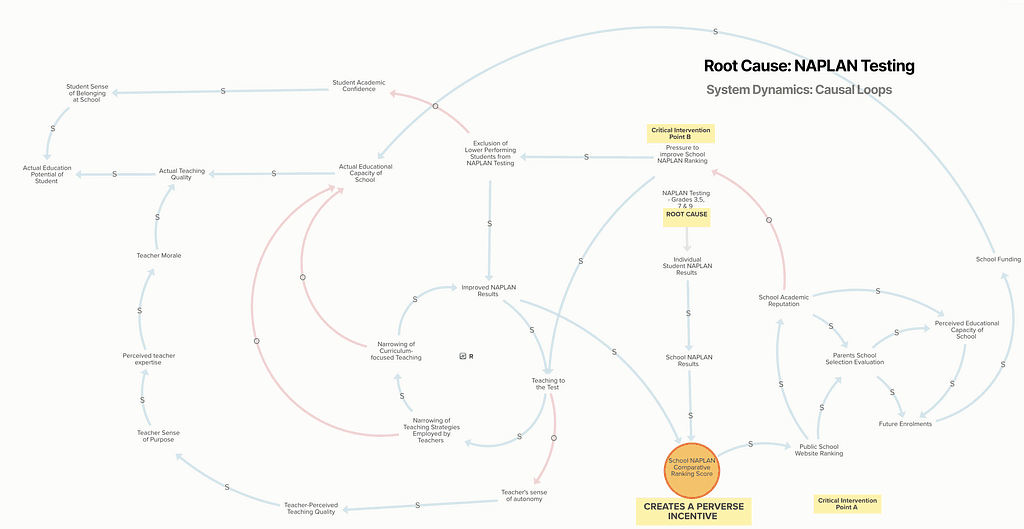
View the live interactive system maps on Kumu here
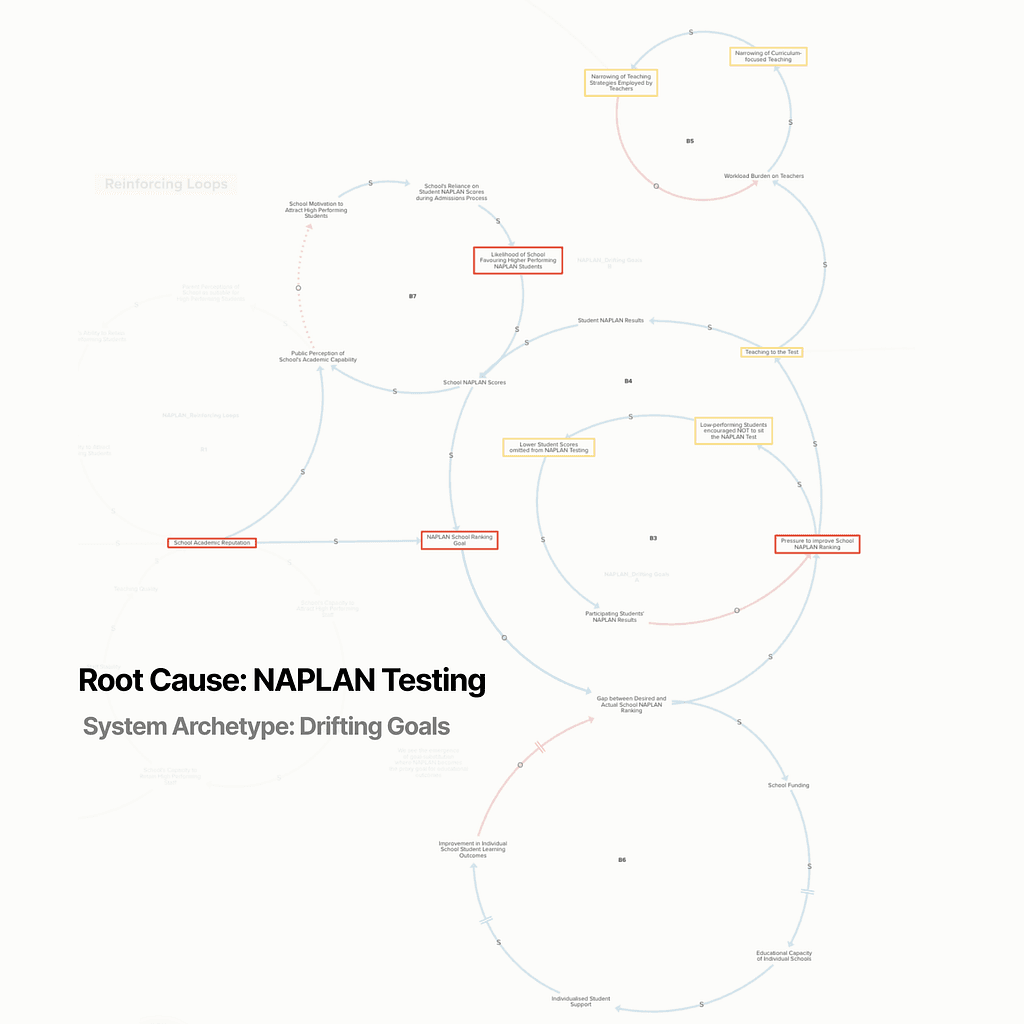
NAPLAN was introduced to create a more equitable education system by allocating resources to underperforming schools. However publicly accessible NALAN scores swiftly became a proxy for school (and student) achievement, creating a perverse incentive which saw the system self-organise around NAPLAN scores as a new goal. These interactions led to the emergence of dysfunctional adaptive behaviour in pursuit of this new goal.
📌 Interconnecting System Dynamics
View the live interactive system maps on Kumu here
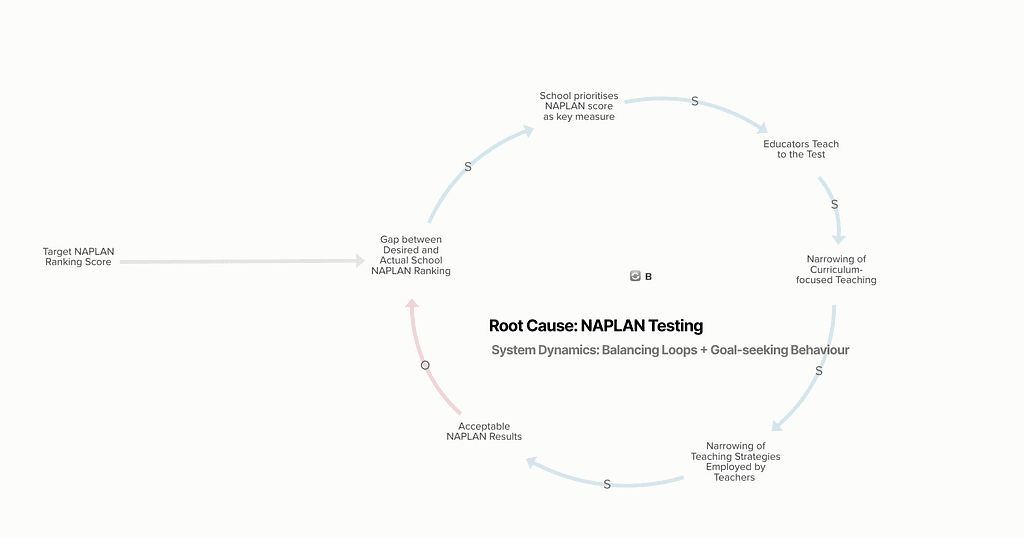
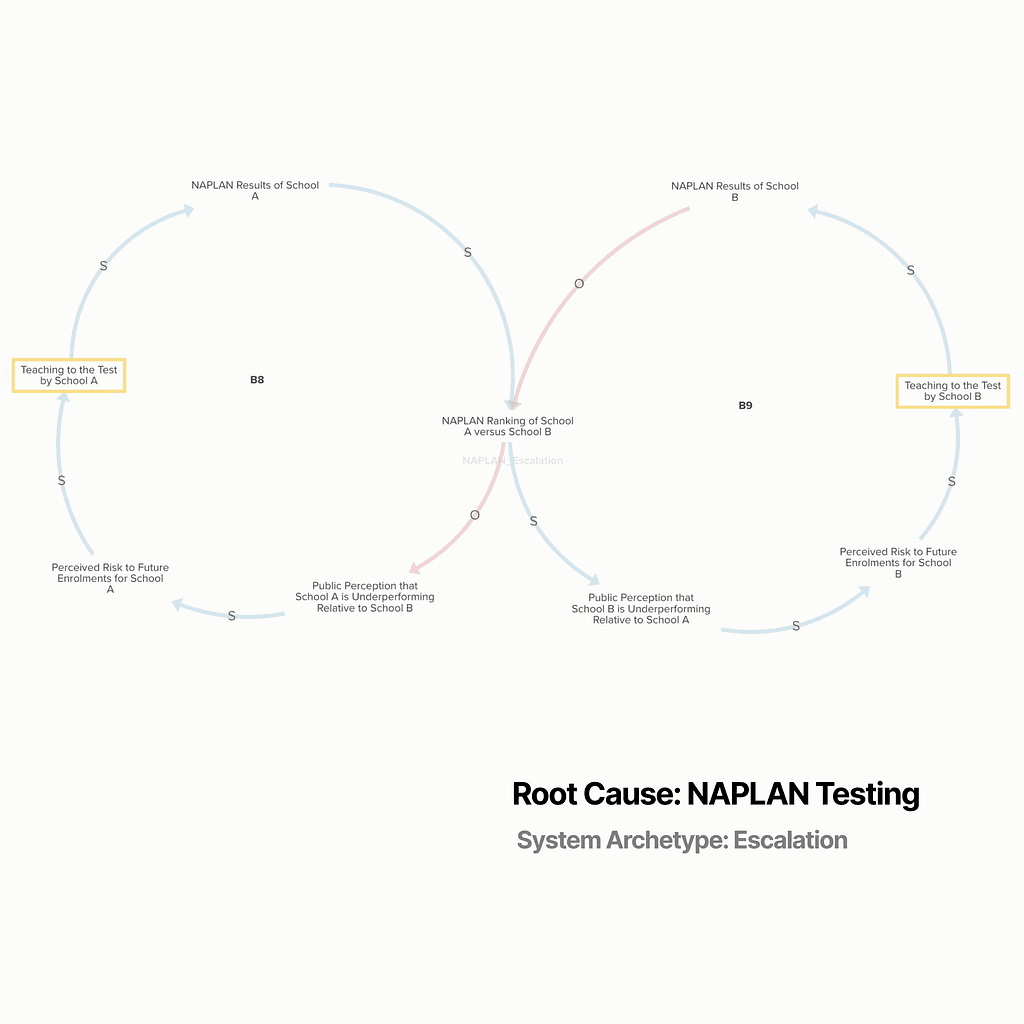
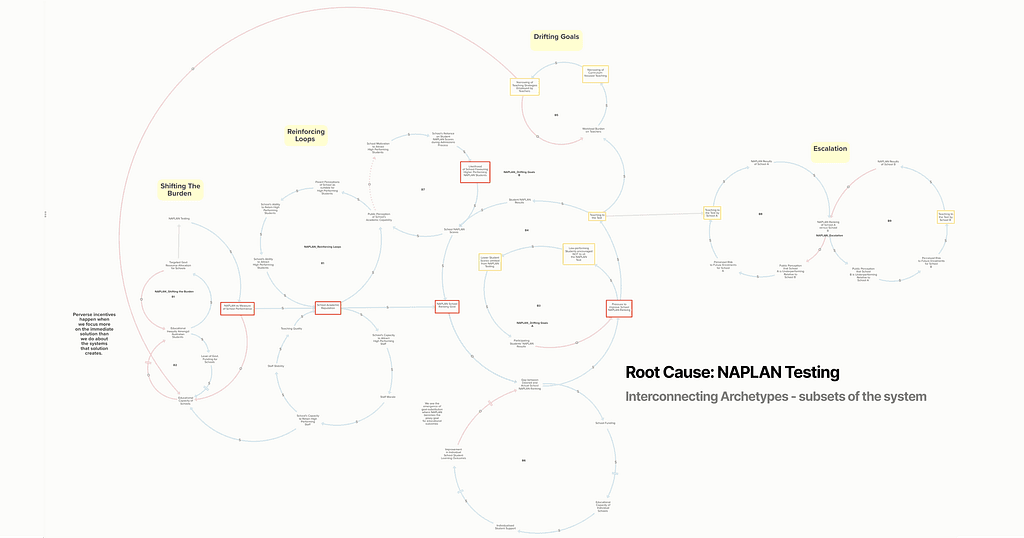
System Dynamics: Balancing Loops, Goal-seeking Behaviour + Escalation within the System
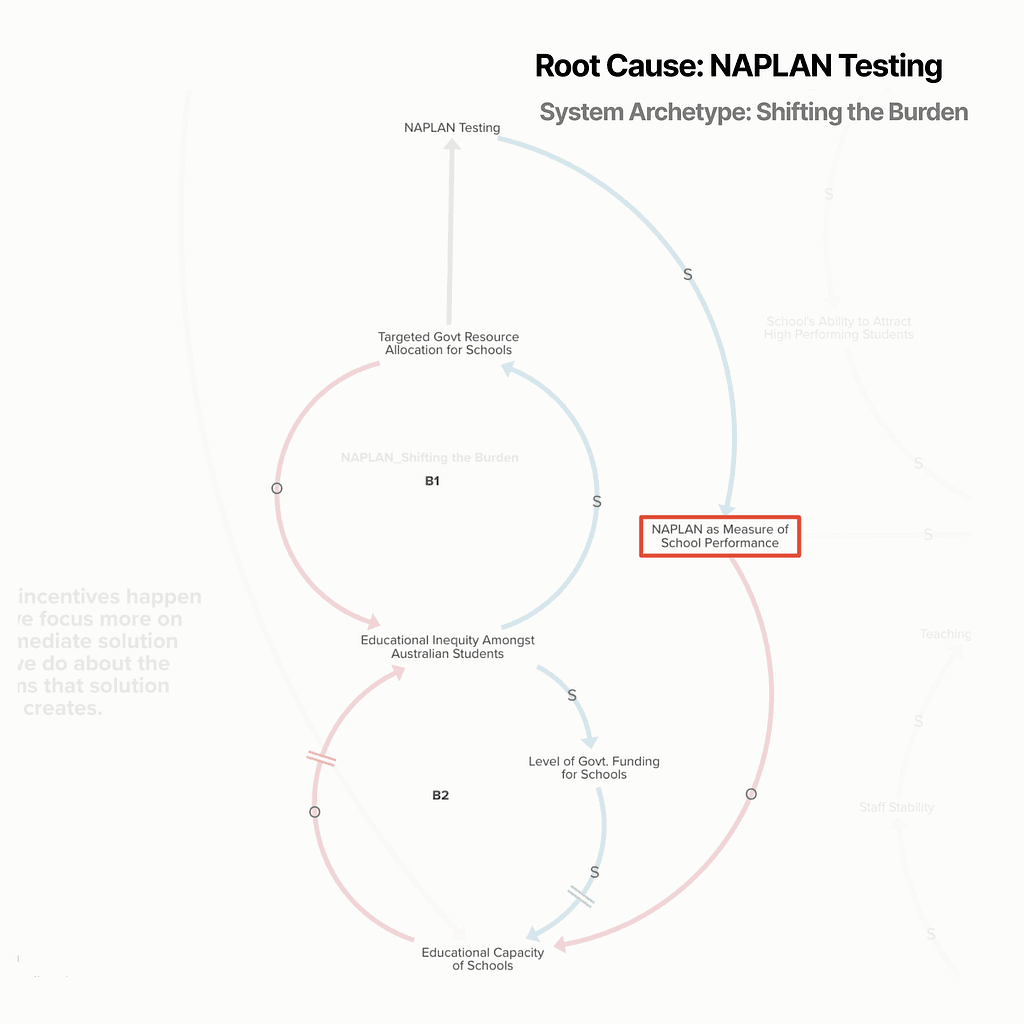

Systems Archetypes: Shifting the Burden, Reinforcing Loops + Drifting Goals
In systems thinking we focus on the interactions between system parts. Here we see that the resetting of system goals around NAPLAN scores as a proxy for academic achievement have led to the emergence of new goal-orientated balancing loops aimed at reducing the gap between the Desired and Actual NAPLAN School Ranking.
View the live interactive system maps on Kumu here
Emerging Changes within the Education Ecosystem
A Future-ready System Story
View the live interactive system maps on Kumu here
📌 System Dynamics: Incoming Emerging Changes
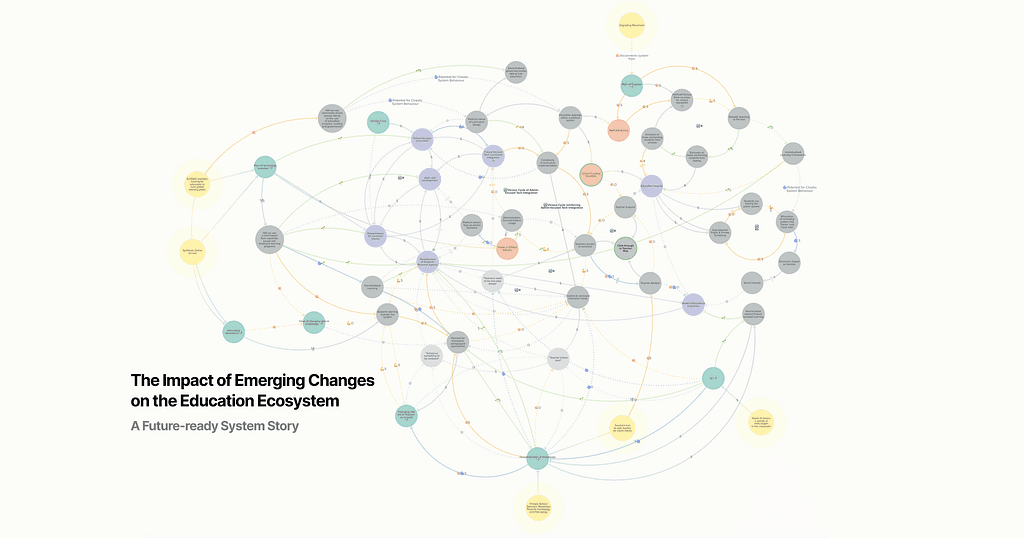
The map above plots the potential impact of six emerging changes.
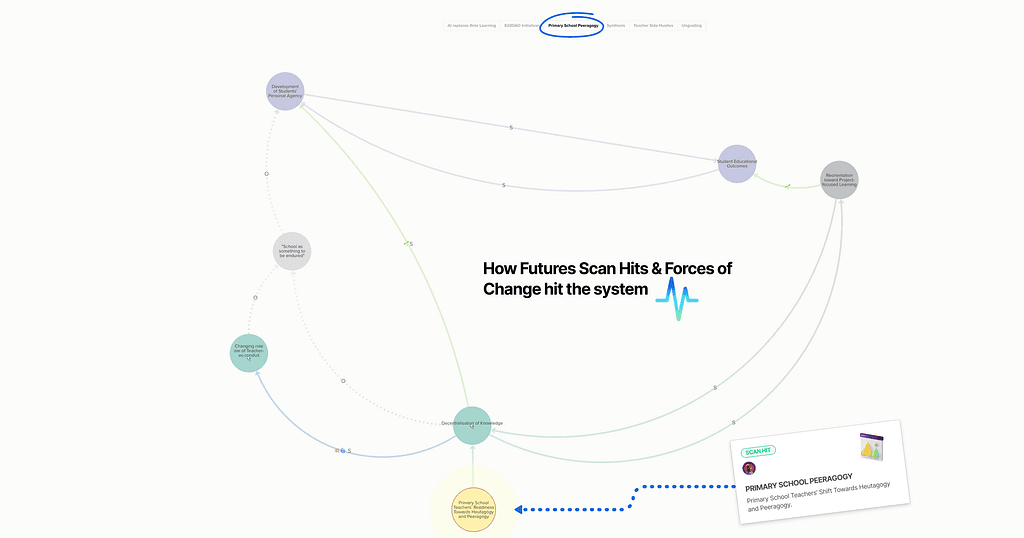
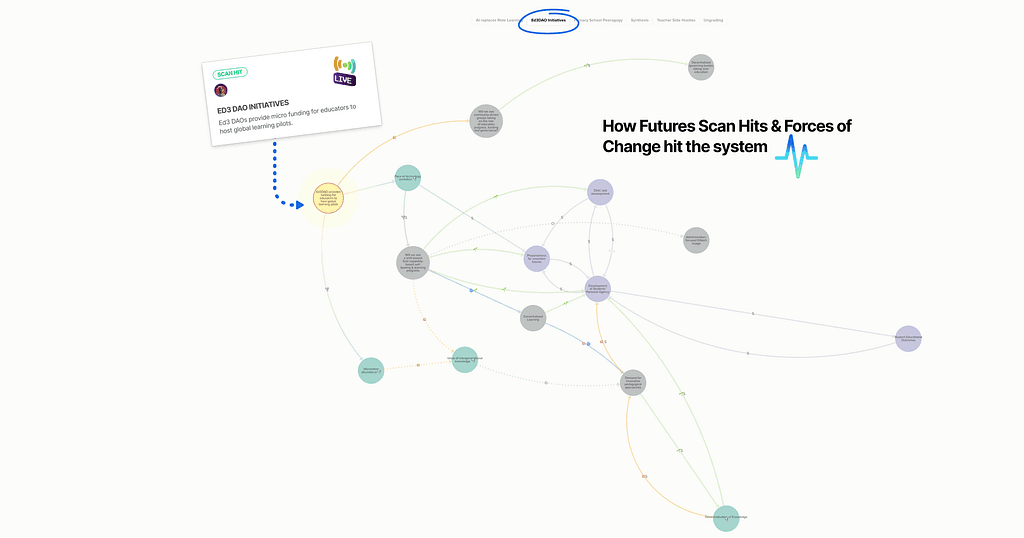
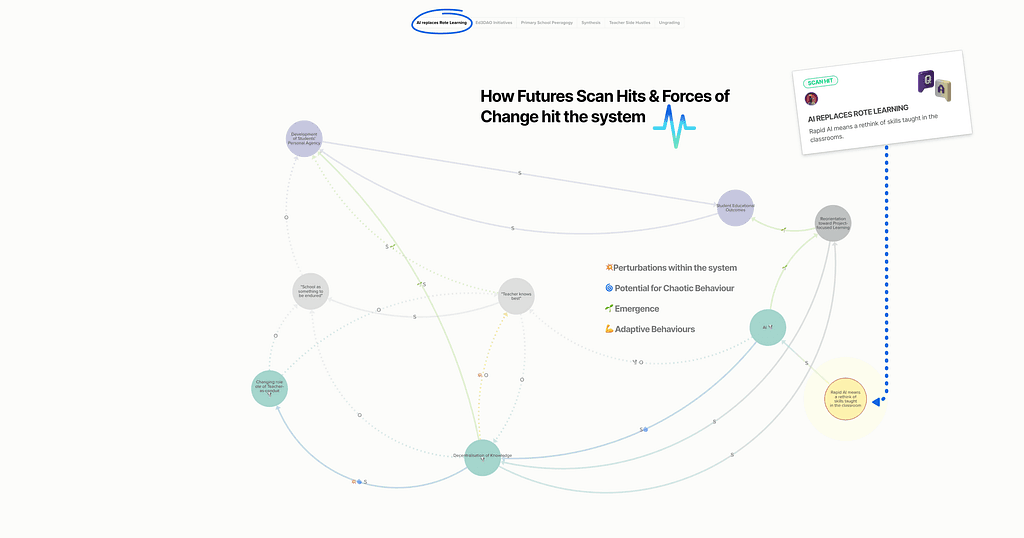
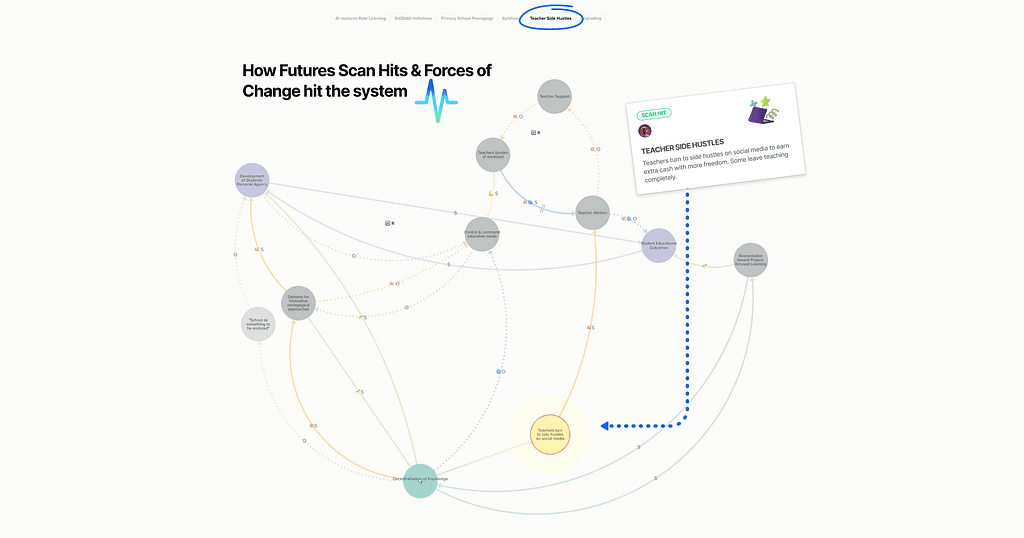
We can see on the map that each of these 🌪️ Emerging Forces of Change creates new perturbations within the system. We can see by following the relationships between emerging forces of change and other variables which are impacted that:
📌 Most Disruptive Change
🔥 The Emerging Change which potentially creates the most significant system disruption on this map (within this limited frame) is the Decentralisation of Knowledge.
We can see that it will cause significant system stress and the potential for chaotic behaviour given it’s potential negative impact on:
We can also see possible system adaptions as this disruption possibly leads to:
The reduction of teacher-centred system rules and mythologies, together with increased pedagogical innovation and decentralisation will likely lead to increased student agency and preparedness for uncertain futures, but not without significant system disruption and potentially chaotic behaviour.
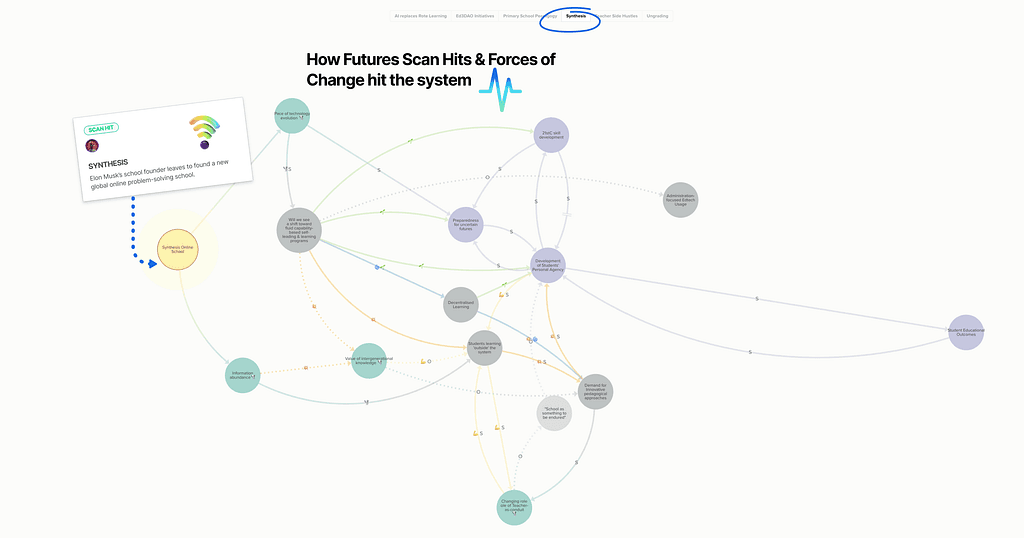
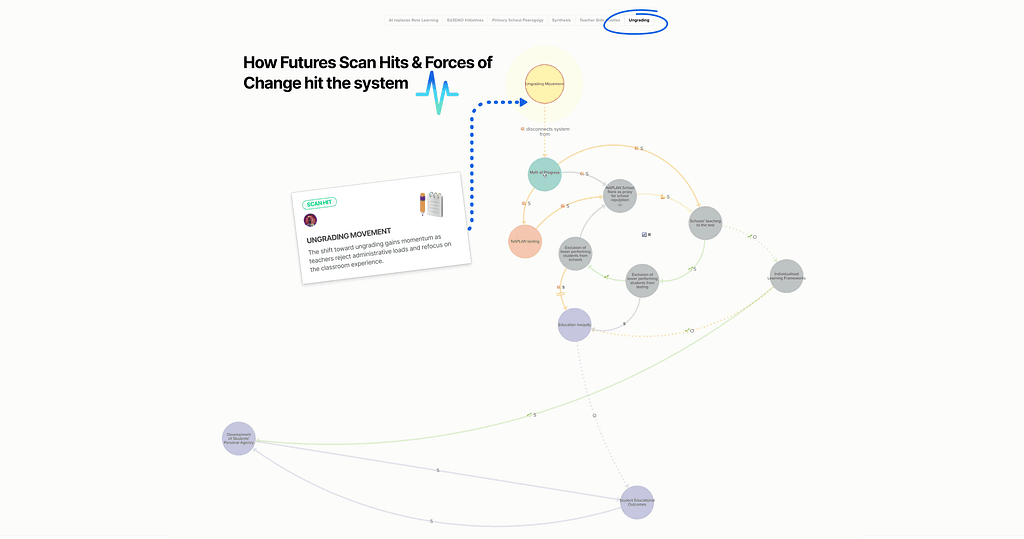
📌 How Scan Hits & Forces of Change hit the system
See how potential changes might hit the education system using controls in the live interactive system maps on Kumu here
2023 Systems Thinking | University of Houston Masters Foresight
Comments and replies live on the original posts.