Essay
Rough Cuts of Tomorrow
Work-in-progress futures research infrastructures out in the open.
Jen Stumbles
·
·
3 min read

01 / The essay
Essay in full, as published.
I tend to treat knowledge work like open-source: ship small, ship early, learn in public.
Last year I spent a bit of time prototyping futures-intelligence setups - small, connected systems that use AI to support human sense-making. Not to replace the hard graft of synthesis, but to try and raise the base level from which my thinking starts - helping me see things from different perspectives and visualise shifts when the world swerves. Whilst I’ve parked these for now, I thought I’d share them here just for fun.
Here’s the loop:
Scanning for weak signals across domains and regions
Mapping fracture & diffractive zones where pressure and possibility meet
Clustering emergent patterns (H1/H2/H3) and test their coherence
Translate patterns into ideas, experiments, and hypotheses
Integrating what I learn back into my own thinking
Posting so others can reuse (or critique) the moves
The approach is less “big fancy report” and more living system: tags that evolve, graphs that reveal relationships, and lightweight prompts that experiment with visualising novelty, impact, or plausibility. The aim isn’t prediction; it’s explicit pattern awareness or option-value.
Building in public means sharing the half-right ideas or builds, the misclassifications the agent made, and the prompts that actually moved the needle. It means keeping tags, graphs, and scoring rubrics forkable - so I can compare notes with others.
What I’m learning is that transparency compounds. Regular signal drops create a trace. Open notebooks invite better questions. Quick-and-dirty visual workflows beat glossy trend decks for real feedback and useful learning so I’m going to make a big effort to take the time to interrogate and reflect as I go.
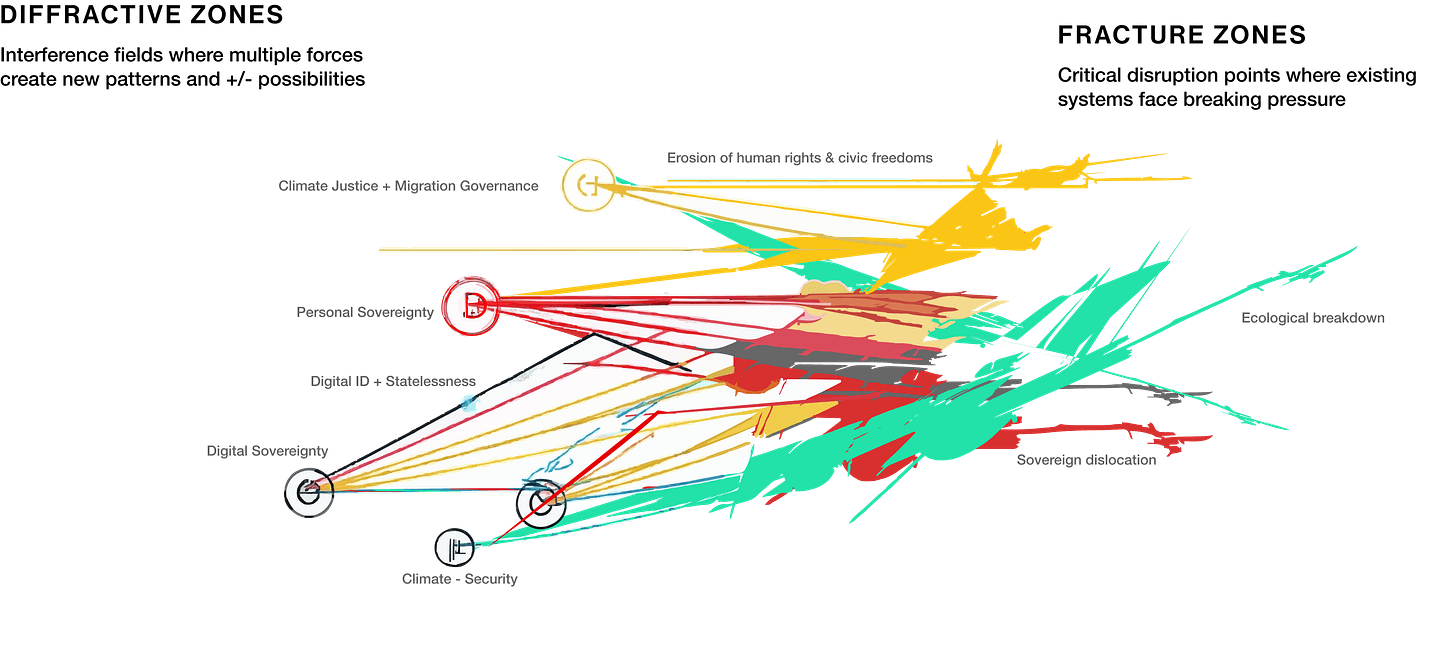
Two imperfect builds from last year I’m sharing here
In advertising we used to call these early creative reviews a “tissue session”—nothing is precious; everything’s testable. Same energy here.
These are just two I spun up over a weekend last year to see what it feels like to see the signals visually surfaced rather than stuck in a database. They’re not “right,” or even close, but they already suggest some relationships are worth mapping (and others less so), and give me a better base for the next iteration.
Build # 1
Build # 2
To say I’m a massive Airtable fan for early build / info architecture planning would be an understatement. I find it a really useful tool to think about what I’m trying to achieve step by step, and to make the process really explicit so I can interrogate / refine it before shifting to a database like Supabase if I’m wanting to try and build a custom front end. . although I’m fast approaching the cost ceiling of what I can trial with in-sheet airtable agent workflows. For those who are interested, Airtable launched a new platform a couple of months ago - Hyperagent which I’m going to play around with next.
What Else
Like everyone since being introduced to Wisprflow I’m a little bit obsessed; and also playing around with Claude cowork to see how it could be helpful.
If you’re working on horizon scanning or innovation-for-good somewhere in a space leaning toward better human futures, especially in development - I’m all ears. Tell me what would be useful.
This isn’t a product play. It’s open research infrastructure - meant to be reused, tested, forked, broken, and rebuilt. Whatever helps.
More soon.
Comments and replies live on the original posts.